


10 Lesser-Known Facts About Diesel Winches

They don’t rely on electricity, but load runaway after engine shutdown is a hazard. Most are fitted with interlocked dual braking systems. Electric winches lock via motor brakes. Once a diesel engine stalls, power is lost. For this reason, diesel winches come with two independent brakes: a drum hand brake and an automatic band brake. The brakes engage automatically when the clutch is disengaged. Even if the diesel engine stops abruptly, suspended loads won’t slide down. Some models include a manual emergency hand crank to safely lower loads if the engine fails, a critical safety feature for field work.

Free spooling is available on some models, yet it is not permitted for all applications. Many diesel winches have a clutch. When the clutch is disengaged, the drum disconnects from the diesel gearbox, and the load’s own weight drives the drum to lower. Note: During free spooling, the engine provides no speed control. Speed is fully controlled by the hand brake. Heavy-load free lowering carries high risks. Work codes prohibit free spooling in many scenarios; only powered slow lowering is allowed.
The diesel engine does not directly adjust pulling force. Pull is controlled by gear selection plus throttle. A bigger throttle does not always mean higher pulling force. The diesel engine supplies torque, while multi-speed gearboxes (high/low/reverse gears) amplify traction.
Low gear: Maximum pulling force, low rope speed, for heavy lifting.
High gear: Reduced pulling force, fast empty rope retraction. Low gear is normally used for utility pole erection in the wild and log skidding in mountains.
High altitude reduces pulling power invisibly. Diesel engines rely on compressed air for combustion. At higher elevations, thin air impairs combustion and cuts power output. For a 5-ton diesel winch, its actual pulling capacity drops noticeably at 3000 m above sea level, below its rated value on the nameplate. Extra safety margin must be reserved during equipment selection. This issue does not exist for electric winches.

Belt-drive units come with built-in overload slip protection. Older single-cylinder diesel winches use V-belts. Under overload, the belt slips instead of breaking the gearbox or engine. Advantage: protects the whole machine by absorbing shock. Disadvantage: Slipping wears belts rapidly, so spare belts are mandatory for field sites. Gear-driven rigid connection models lack this buffer; overload can fracture gears directly.
Diesel winches sustain long continuous operation but have poor positioning precision. Electric winches cannot run continuously at full load for long periods due to motor overheating. Internal combustion diesel engines are built for prolonged heavy-duty running. However, unlike variable-frequency electric winches with precise positioning, diesel winches depend on operator feel and brake control. They suit rough field pulling instead of precision indoor hoisting.
Diesel has a higher flash point than gasoline, safer for field use, yet exhaust poses fire risks. Diesel is harder to ignite instantly by open flame, so diesel winches carry lower wildfire risk than gasoline versions in mountain sites. Still, hot exhaust gases are dangerous in wooded areas. Spark arrestors must be fitted on exhaust pipes to avoid igniting dry grass.
Custom drums can hold extremely long wire rope for mountain cross-valley cableways. Custom winch drums can spool thousands of meters of wire rope. They are widely used for material transport across mountain valleys, logging and overhead power line stringing. One long rope can span valleys without intermediate transfer equipment, which explains their popularity in mountain engineering.
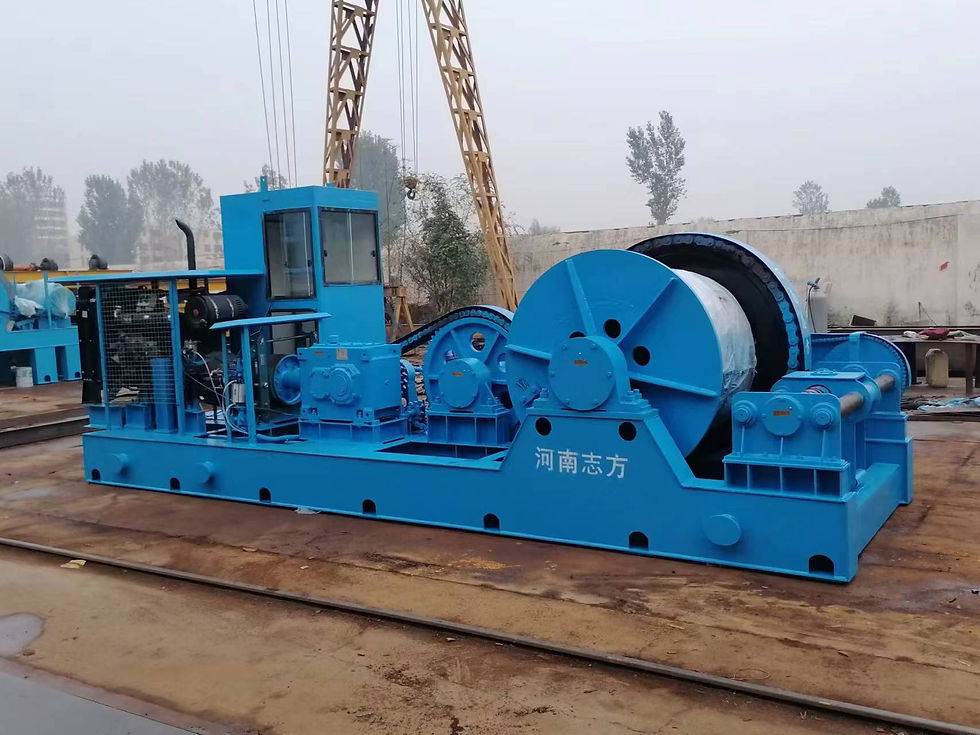
They can be converted into marine anchor winches with special anti-corrosion treatment. Marine diesel winches require salt spray protection on frames, drums and gearboxes plus water-cooled exhaust. Ordinary construction diesel winches will rust and seize within months if used directly at sea.
Common misconception: rated pull applies only to the first layer of wire rope. When wire rope is wrapped in multiple layers on the drum, the pulling capacity of outer rope layers decreases. The tonnage marked on the nameplate is valid only for the innermost rope layer. Actual pulling force falls as more rope is wound onto the drum.


Comments